
€1000 Rabbit Road Deposit — How a Large Balance Transforms Session Length and Player Experience
What a €1000 Balance Really Means Inside Rabbit Road
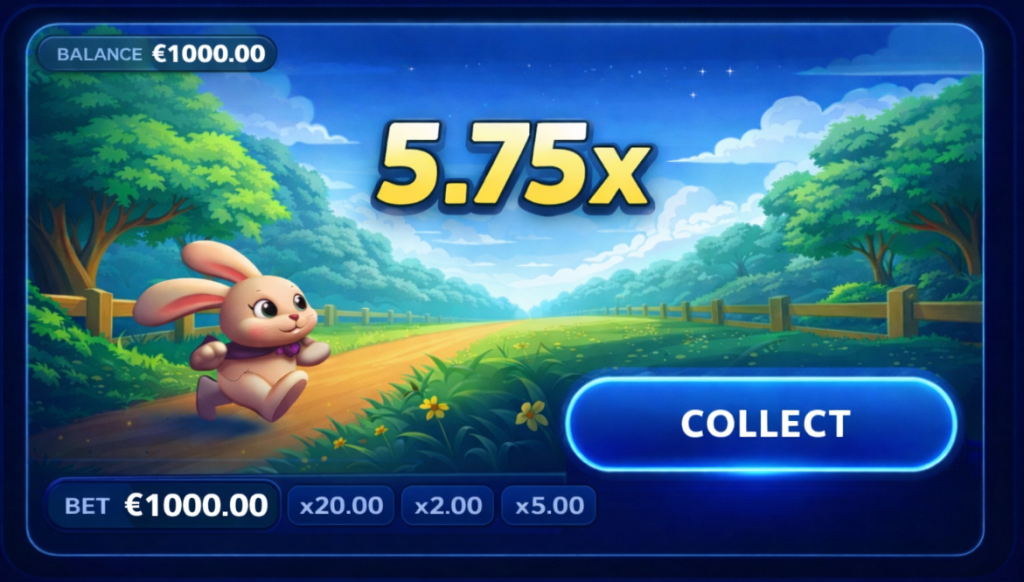
A €1000 balance in Rabbit Road does not change how the game behaves. It does not alter the multiplier, it does not influence when a round will end, and it does not introduce any hidden advantage. The system remains exactly the same at every level. What changes is not the game itself, but the scale at which the player experiences it.
Rabbit Road is built on a simple structure. Each round begins at a low multiplier, which increases over time until it suddenly stops. That stopping point is independent of any player action. The only decision available is when to exit the round before the crash occurs. There are no reels, no paylines, and no combinations to follow. Every round is self contained, and nothing carries over into the next one.
Within this structure, a €1000 balance introduces something that smaller deposits cannot provide. It creates duration. It creates a longer session, and that longer session changes how the system is perceived. The same mechanics begin to feel different, not because they have changed, but because they are repeated more times.
A small balance compresses the experience. Decisions arrive quickly, outcomes feel immediate, and the session ends before any sense of rhythm can develop. A €1000 balance stretches that experience. It allows for dozens, and often hundreds, of rounds. That extension creates space between outcomes. Losses do not end the session instantly, and gains do not define it. Everything becomes part of a longer sequence rather than a short event.
This shift is subtle but important. The player is no longer reacting to isolated rounds. Instead, they are moving through a continuous flow of decisions. The game begins to feel less abrupt and more structured, even though the underlying randomness remains untouched.
At this level, the balance stops being a number and becomes a timeline. It represents how long the player will remain inside the system, how many decisions they will make, and how many times they will face the same moment of choice. That is what €1000 truly represents. Not power, not control, but exposure over time.
Why This Is Not About Winning More but Experiencing More
It is easy to assume that a larger balance increases the chances of winning. The logic appears straightforward. More money should create more opportunities, and more opportunities should lead to better results. In Rabbit Road, that assumption does not hold.
The system does not recognise balance size. Each round is generated independently, and its outcome is determined without reference to previous rounds or current funds. A player with €1 and a player with €1000 are placed into the same structure. The only difference is how long they remain there.
A larger balance does not improve outcomes. It multiplies experiences. It allows the player to participate in more rounds, make more decisions, and observe more variations of the same behaviour. The range of possible results does not change, but the number of times those results can occur increases significantly.
This creates an important distinction. A €1000 session is not a stronger position within the game. It is a longer interaction with the same conditions. Every high multiplier that appears at this level could have appeared at any other level. Every early crash remains just as possible. Nothing becomes more favourable. Everything simply becomes more frequent.
With more rounds comes more exposure to both positive and negative outcomes. Gains are not guaranteed to accumulate, and losses are not prevented from appearing. The system does not balance itself in response to time spent or money used. It continues to operate independently, round after round.
What changes is the player’s relationship with those outcomes. A single loss within a small balance can feel decisive. The same loss within a €1000 session may feel insignificant, absorbed into a larger sequence of events. The impact of each round becomes smaller relative to the session as a whole.
This can create the impression that the game has become more manageable. In reality, it has only become less immediate. The decisions are still the same. The uncertainty is still present. The difference lies in how those elements are distributed across time.
A €1000 balance therefore shifts the focus away from individual results and towards the overall experience. It transforms the game from a short sequence of outcomes into an extended process of decision making. The player is no longer trying to reach a result quickly. They are moving through a series of moments, each one identical in structure, but different in outcome.
This is why the question is not whether a €1000 balance leads to more wins. The more accurate question is how it changes the way those wins and losses are experienced. The answer is simple. It does not improve them. It stretches them.
From Deposit to Decisions: The Hidden Structure Behind €1000
How €1000 Turns Into Time, Choices and Deeper Contact With the System
In Rabbit Road, a €1000 balance is not important because of its face value alone. Its real function is structural. It extends the session, creates more rounds, produces more decision points, and increases how long the player remains inside the same uncertain cycle. This flow shows how one deposit is converted into a full session experience.
Deposit
The starting balance sets the scale of the session and determines how much room the player has before the experience begins to compress.
Rounds
A larger balance opens the door to many more entries into the same crash structure, which immediately changes session length.
Decisions
Every round creates another moment of choice, so a longer session means repeated timing decisions rather than a change in game mechanics.
Exposure
More rounds and more choices increase total contact with uncertainty, which is why €1000 changes depth of experience rather than control.
To understand what €1000 truly does inside Rabbit Road, it is necessary to look beyond the balance itself and examine the structure it creates. The deposit is only the starting point. What follows is a chain of consequences that defines the entire session.
The first transformation is from money to rounds. A €1000 balance allows for a significantly higher number of rounds than smaller deposits. The exact number depends on stake size, but the principle remains constant. More balance means more entries into the same repeating system.
The second transformation is from rounds to decisions. Each round contains a single critical moment. The decision of when to exit. This decision is repeated every time a new round begins. As the number of rounds increases, so does the number of decisions. A €1000 session can contain dozens or even hundreds of these moments.
The third transformation is from decisions to exposure. Every decision is made under uncertainty. The player does not know when the round will end and cannot influence it. Repeating this situation many times increases total exposure to that uncertainty. The player is not gaining control over it. They are encountering it more often.
This structure reveals the true function of a large balance. It does not improve decision quality. It increases decision frequency. The player is placed into the same scenario again and again, with no change to the rules governing it.
Over time, this repetition begins to shape perception. Patterns seem to appear, not because they exist, but because the mind searches for them. Sequences of outcomes feel meaningful, even though they are independent. The player begins to interpret the flow of rounds as if it contains information.
This is where the hidden structure becomes most visible. The system has not changed, but the volume of interaction with it has increased. That volume creates familiarity. Familiarity creates confidence. Confidence creates the impression of understanding.
In reality, nothing new has been introduced. The same uncertainty remains at the core of every round. The same decision is required, and the same lack of control defines it. What has changed is the number of times the player has encountered this situation.
A €1000 balance therefore builds a layered experience. At the surface, it appears smoother, longer, and more stable. Beneath that surface, the same mechanics continue to operate without variation. The structure is repeated, not evolved.
Understanding this chain from deposit to rounds, from rounds to decisions, and from decisions to exposure clarifies the role of a large balance. It is not a tool for influencing outcomes. It is a framework that determines how often those outcomes are faced.
This is the foundation of the entire session. Everything that follows, including perception, behaviour, and interpretation, emerges from this structure. The balance does not change the game. It defines how long the player remains inside it and how many times they will confront the same uncertain moment.
From Money to Time: How €1000 Expands the Session Into Hundreds of Decisions
A €1000 balance changes the scale of the session by transforming money into time. Inside Rabbit Road, value is not expressed through ownership but through duration. The balance determines how long the player can remain active, how many rounds can be entered, and how many decisions will be required before the session ends.
At lower levels, the structure is compressed. The number of rounds is limited, and each decision carries visible weight. A single mistake can significantly reduce the remaining balance. The session feels tight, and every action appears critical. There is little room for adjustment, and almost no space for observation.
At €1000, this compression disappears. The same system unfolds over a longer period. The player is no longer confined to a small number of rounds. Instead, they move through an extended sequence of repeated interactions. The structure becomes less about immediate outcomes and more about ongoing participation.
This expansion introduces a shift in how decisions are experienced. Each individual choice becomes less dominant within the session as a whole. One early exit or one missed multiplier does not define the outcome of the entire experience. It becomes one point within a larger sequence.
The key transformation here is not mechanical but structural. The rules of the game do not adapt to the balance, but the balance changes how those rules are encountered. The player is placed into the same situation repeatedly, but the frequency of repetition alters how that situation feels.
Time becomes the central variable. A €1000 balance does not increase influence over the system, but it extends the period of interaction with it. The player is not making better decisions. They are making more decisions. That distinction defines the entire session.
Over time, this creates continuity. The game no longer feels like a series of isolated rounds. It begins to feel like a single extended process, where each round connects to the next through the player’s experience rather than through the system itself. The structure remains independent, but perception links it together.
This is how €1000 expands the session. It does not change what happens inside each round. It changes how many times that same moment occurs, and how it is perceived across time.
Why the Game Feels Slower Even Though Nothing Has Changed
The pace of Rabbit Road is constant. Each round begins, the multiplier rises, and the crash occurs without regard for balance size. The speed of this process does not adjust based on how much money is available. However, a €1000 session often feels slower.
This perception is created by spacing. With a larger balance, outcomes are distributed across more rounds. The player is not forced into immediate conclusions. Losses are absorbed into the session rather than ending it, and gains do not dominate the experience. Everything is spread out.
In shorter sessions, events appear closer together. The start and end of the session are tightly connected, and every result feels significant. In longer sessions, those same events are separated by additional rounds. The distance between meaningful moments increases, even though the internal speed of each round remains identical.
This creates a sense of reduced urgency. The player is not reacting under pressure to preserve a small balance. Instead, they are moving through a sequence where the immediate impact of each decision is less visible. The need to act quickly feels diminished, even though the system itself has not slowed down.
The absence of immediate consequence changes behaviour. Decisions may become more relaxed, and the player may wait longer within rounds. The multiplier continues to rise at the same rate, but the perception of risk is softened by the presence of a larger balance.
This does not make the game safer. It changes the way time is experienced within it. The same risk exists, but it is encountered within a wider context. The player is less focused on individual outcomes and more immersed in the flow of the session.
The feeling of slowness is therefore not a property of the game. It is a property of the session structure created by €1000. The mechanics remain constant, but the spacing between their effects changes how they are interpreted.
How Risk Gets Spread Across the Session Without Ever Decreasing
Pressure per decision across the session
A short balance keeps pressure high early on. A €1000 session spreads the same uncertainty across more rounds, making each decision feel less intense without reducing risk.
Risk in Rabbit Road is defined at the level of each round. The uncertainty of when the multiplier will stop exists independently of balance size. A larger deposit does not reduce this uncertainty, and it does not protect against unfavourable outcomes.
What a €1000 balance does is distribute that risk across a greater number of rounds. Instead of being concentrated into a short sequence, it is extended over time. Each individual outcome represents a smaller proportion of the total session.
This distribution changes how risk is perceived. In a short session, losses are immediate and visible. The balance declines quickly, and the consequences of each decision are clear. In a longer session, those same losses are absorbed into a broader structure. The decline is less abrupt, and the impact of each round appears reduced.
This can create the impression that risk has been lowered. In reality, it has only been redistributed. The same level of uncertainty remains present in every round. The system does not adjust its behaviour to match the size of the balance.
The player encounters the same probability of early crashes, the same potential for high multipliers, and the same lack of control over outcomes. These elements do not change. What changes is how often they are experienced and how strongly they are felt within the session.
As the number of rounds increases, the influence of any single outcome decreases. This leads to a smoother progression, where the balance changes gradually rather than sharply. The session appears more stable, even though the underlying variability has not been reduced.
Over time, this smoothing effect can influence behaviour. The player may become less sensitive to losses and more willing to remain in rounds longer. The distribution of risk across many decisions reduces the immediate feedback that would otherwise signal caution.
This is where the structure becomes significant. By spreading risk across a longer session, €1000 alters the way uncertainty is experienced without altering uncertainty itself. The system continues to operate in the same way, but the player interacts with it under different conditions.
Risk is not removed, reduced, or controlled. It is extended. It becomes part of a longer process, where its presence is constant but its visibility is reduced. This distinction defines the experience of a €1000 session.
When Repetition Starts to Look Like Structure
A €1000 session introduces a level of repetition that smaller balances cannot sustain. The same round format appears again and again, and with enough exposure, the mind begins to organise these repetitions into something that feels structured.
Each round is independent. The multiplier rises, stops, and resets. There is no memory in the system and no connection between outcomes. Yet when this process is repeated dozens or hundreds of times, it no longer feels isolated. The player starts to experience it as a sequence.
This is where perception begins to shift. Repetition creates familiarity, and familiarity encourages interpretation. Sequences of low multipliers may appear meaningful, and occasional high multipliers may seem like signals. The randomness does not disappear, but it becomes layered with meaning that is not actually present.
The longer the session, the stronger this effect becomes. The player is no longer seeing single rounds. They are seeing relationships between rounds that do not exist. The system remains random, but the experience begins to resemble order.
Why €1000 Creates a Stronger Illusion of Control
As repetition builds familiarity, familiarity begins to influence behaviour. The player starts to feel more comfortable within the system. Decisions that once felt uncertain begin to feel informed.
This is where the illusion of control develops. With a €1000 balance, the player has enough time to observe many outcomes. That observation creates a sense of understanding. It feels as though the player has learned how the game behaves, even though the behaviour has not changed.
The illusion appears as confidence. The player begins to trust their judgement and may feel able to recognise when to exit earlier or later. These decisions feel guided by experience.
In reality, the system does not provide information that can be used to predict outcomes. Each round remains independent. The multiplier does not follow a pattern that can be learned.
What has changed is not the system, but the player’s interpretation of it. A larger balance creates enough repetition to simulate understanding. The player is not gaining control. They are gaining confidence.
The False Confidence Zone: Where Familiarity Becomes Belief
As the session continues, familiarity deepens. The player has seen enough rounds to feel comfortable, and that comfort begins to turn into belief.
The player may begin to think they understand how the multiplier behaves. They may expect certain outcomes to follow others or feel that they can anticipate when a round will end. These beliefs are formed through repetition, not through evidence.
This stage can be described as a zone of false confidence. It is created by experience, but it is not supported by any change in the system. The same randomness continues to define every round.
This matters because it changes behaviour. Decisions may become more assertive. The player may stay in rounds longer or rely more on instinct. These actions are based on perceived understanding rather than real information.
The system does not respond to this confidence. Outcomes remain independent. The gap between perception and reality does not close.
Decision Fatigue: What Happens After Dozens of Rounds
A €1000 session extends not only the number of rounds but also the number of decisions. Each round requires the same choice, and over time, this repetition begins to affect how those choices are made.
At the beginning, decisions are deliberate. The player is focused and attentive. As the session progresses, this focus can decline. Repeated decision making creates fatigue.
This fatigue develops gradually. The player becomes used to the process, and decisions may become more automatic. Less attention is applied to each round, and actions may be repeated without full evaluation.
This changes the quality of decision making. The player may rely on habit instead of awareness. At the same time, the illusion of control may still be present, creating a combination of confidence and reduced attention.
The system remains unchanged. Each round carries the same uncertainty. The player’s behaviour shifts, but the game does not.
A €1000 balance therefore introduces sustained decision making. Over time, this leads to fatigue, which becomes part of the session itself.
Exposure Over Time: The Real Cost of a Long Session
A €1000 balance extends the session far beyond what smaller deposits can sustain. This extension does not change the nature of the system, but it increases the amount of time the player spends inside it. That time is not neutral. It represents repeated contact with uncertainty.
Each round carries the same conditions. The multiplier rises without guarantee, and the outcome cannot be predicted or influenced. When this situation is encountered a few times, its impact is limited. When it is encountered dozens or hundreds of times, the total exposure increases significantly.
Exposure is not about individual outcomes. It is about how often the player is placed in the same uncertain position. A longer session means more entries into that position. The player is not protected from risk. They are interacting with it more frequently.
This is the real cost of duration. A €1000 balance does not reduce volatility or stabilise outcomes. It creates a longer sequence of interactions where the same level of uncertainty is repeated again and again. Over time, this repetition accumulates.
The session may feel smoother because individual results carry less weight, but the overall exposure continues to grow. The player remains inside the system for longer, facing the same decision point each round. That repeated exposure defines the experience more than any single result.
Why €1000 Does Not Make the Game Safer but Only Longer
A larger balance can feel safer because it removes immediate pressure. The session does not end quickly, and losses are absorbed into a wider sequence. This creates a sense of stability, but that stability is only superficial.
The level of risk in each round does not change. The system does not adjust based on balance size. Early crashes remain possible, high multipliers remain unpredictable, and no outcome becomes more or less likely.
What changes is the distribution of those outcomes across time. Instead of being concentrated in a short session, they are spread across a longer one. This reduces the intensity of individual moments but does not alter the underlying conditions.
The perception of safety comes from duration. The player has more time to act, more rounds to play, and more chances to continue. This can create the impression that the session is under control.
In reality, control has not increased. The same uncertainty remains present in every round. A €1000 balance does not protect the player from outcomes. It allows them to encounter more of them.
Length replaces intensity, but risk remains constant. The session becomes longer, not safer.
The Difference Between Staying Longer and Winning More
What Actually Changes When the Session Gets Longer
A larger balance does not improve outcomes, but it changes how the session unfolds. This comparison shows how €1000 reshapes the experience without affecting the system itself.
| Factor | Small Deposit | €1000 Deposit |
|---|---|---|
| Session length | Short | Long |
| Number of decisions | Low | High |
| Pressure per decision | High | Lower |
| Perceived control | Low | High |
| Actual control | Same | Same |
| Risk per round | Same | Same |
A longer session can create the impression of progress. The player remains active, continues to make decisions, and experiences a wide range of outcomes. This can feel like movement towards a result.
However, staying longer inside the system is not the same as improving results. Each round remains independent. There is no accumulation of advantage, and no mechanism that rewards duration.
A €1000 balance allows the player to continue, but continuation does not influence outcomes. The system does not recognise how long the player has been active or how many rounds have already occurred.
This distinction is important because it separates experience from outcome. A long session may feel productive, but it does not create better conditions. It simply extends the interaction with the same system.
Winning is defined by individual rounds. Staying is defined by balance. These two elements are not connected. A player can remain in the game for a long time without achieving favourable results, just as a player can experience a high multiplier early in a short session.
A €1000 balance therefore changes duration, not outcome. It allows the player to remain inside the system for longer, but it does not improve what happens within it.
€1000 Rabbit Road FAQ What Really Changes and What Never Does
€1000 in Rabbit Road A Longer Experience Inside the Same Unchanged System
A €1000 balance does not transform Rabbit Road into a different game. The same structure defines every round, and the same uncertainty shapes every outcome. Nothing becomes more predictable, and nothing becomes more controlled.
What changes is the scale of the experience. The session becomes longer, the number of decisions increases, and the interaction with the system deepens. This creates a smoother, more continuous experience, where individual results carry less immediate weight.
This extended structure can feel more stable, but that stability is only a reflection of duration. The underlying conditions remain unchanged. Risk is not reduced. It is repeated.
A €1000 session therefore represents a longer journey through the same system. It offers more time, more decisions, and more exposure, but it does not offer greater control or improved outcomes.
The difference is not in how the game works, but in how long the player remains inside it.