
€20 Rabbit Road — How a Medium Deposit Reshapes the Session Without Changing the Game
A €20 Session Feels Different, But Nothing Inside the Game Has Changed
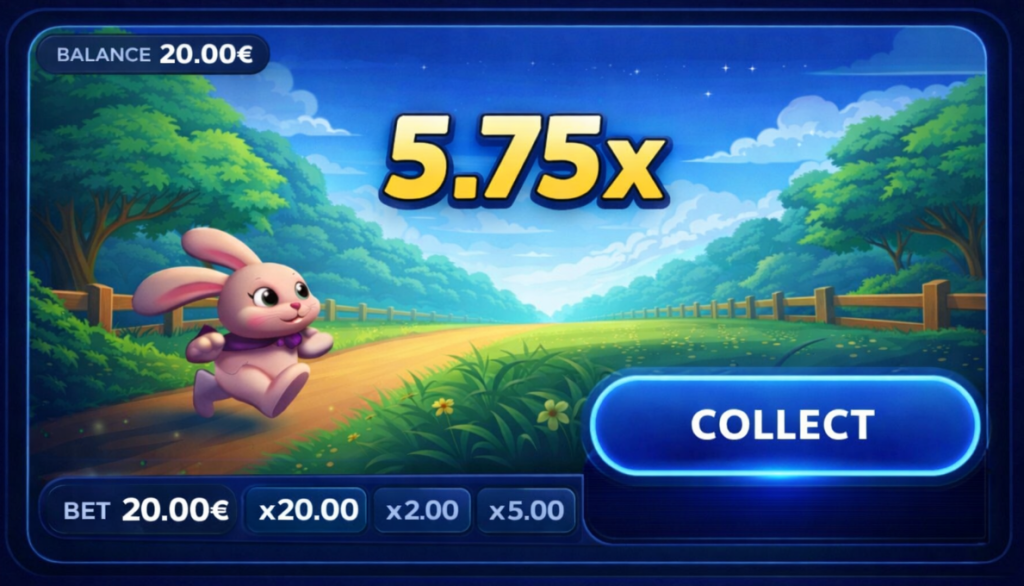
A €20 balance introduces a noticeable shift in how Rabbit Road feels from the first few rounds. The session lasts longer, decisions are not as compressed, and the pace appears more manageable. This creates an immediate impression that something inside the game has improved. In reality, nothing within the system has changed at all.
Rabbit Road does not operate like a traditional slot. There are no reels, no paylines, and no combinations that determine outcomes. Each round begins with a multiplier that rises from a fixed starting point and continues upward until it stops abruptly. That stopping point is not influenced by the player. It is not delayed by patience, nor accelerated by hesitation. It simply occurs.
The only interaction available is the moment of exit. The player chooses when to collect, but never controls when the round ends. This distinction is central. A €20 deposit does not move this boundary. It does not extend the multiplier, soften the crash, or introduce patterns that can be learned. The structure of each round remains identical, regardless of balance.
What changes is the environment around those rounds. With €20, there are more opportunities to observe outcomes, more chances to exit at different points, and more space between mistakes. A small balance compresses all of this into a short sequence, where each decision carries immediate weight. A €20 session stretches that same sequence into a longer experience.
This stretching alters perception. The game appears calmer because there is less urgency per decision. It appears more consistent because the player is exposed to more rounds. It appears more understandable because repetition creates familiarity. None of these impressions come from the system itself. They emerge from the length and structure of the session.
The multiplier reinforces this effect. As it rises, it creates tension that grows with time. This tension is not a reward. It is a form of pressure that builds until it breaks. With a €20 balance, the player encounters this pressure repeatedly, but in smaller portions per decision. That makes each moment feel easier to manage, even though the total exposure to the system increases.
This is where misunderstanding often begins. A longer session feels smoother, and smoothness is easily interpreted as control. However, control has not increased. The player still operates within the same constraint: choosing when to exit without any influence over when the round ends. The system does not adapt, respond, or learn. It remains fixed.
A €20 deposit therefore introduces a shift in experience without introducing any change in mechanics. It creates room to think, but not the ability to influence. It reduces the intensity of individual moments, but not the uncertainty behind them. The player feels more stable, yet remains inside a system that behaves exactly as before.
Understanding this distinction is essential. The difference between a short session and a longer one is not about outcomes. It is about how those outcomes are distributed across time. The system remains constant. The experience expands around it.
€20 as a Structural Threshold — Where Sessions Stop Feeling Random and Start Feeling Manageable
Why a €20 Balance Starts to Feel More Settled Without Becoming More Predictable
A longer session creates repeated exposure to the same round logic. This makes the experience feel calmer, even though uncertainty remains unchanged.
What this shows
More rounds create familiarity, which feels like stability.
The system does not change. Only perception becomes smoother.
At lower balance levels, Rabbit Road feels abrupt. A small number of rounds creates a compressed experience where outcomes follow one another without pause. There is little time to observe, reflect, or adjust. The session ends before any sense of structure can form.
A €20 deposit shifts this dynamic. It introduces enough depth for the session to begin organising itself into something that feels more coherent. The player is no longer reacting to a rapid sequence of events. Instead, the experience unfolds over a longer series of rounds, allowing patterns to appear where previously there was only noise.
This is not because the system becomes more predictable. It is because the number of observations increases. With more rounds, the player encounters a wider range of multiplier behaviours. Some rounds end early, others extend further, and a few reach higher values. Over time, this variation creates a sense of balance, even though each round remains independent.
The key change at €20 is not in the outcomes themselves, but in how they are distributed. Short sessions tend to cluster outcomes in ways that feel extreme. A few early crashes can dominate the entire experience. In contrast, a longer session spreads these events out. Early losses are absorbed into a broader sequence, and later rounds dilute their impact.
This distribution creates a rhythm. The player begins to recognise the pacing of the game, even if that pacing is not controlled by any underlying pattern. The repetition of rounds produces familiarity, and familiarity reduces the feeling of randomness. The game starts to feel manageable, not because it has become stable, but because it has become extended.
Manageability is closely tied to time. With more rounds available, decisions can be spaced out. There is less pressure to act immediately, and more opportunity to observe how the multiplier behaves across different rounds. This gives the impression that the player is adapting to the system, when in fact the system remains unchanged.
The threshold at €20 is where this illusion becomes strong enough to influence behaviour. The player begins to trust their timing, to believe that certain exit points are more reliable, or that recent outcomes provide some form of guidance. These beliefs emerge naturally from repeated exposure, but they are not supported by the structure of the game.
Each round still operates independently. The multiplier does not remember previous values, and the system does not adjust based on player behaviour. What appears as a developing pattern is simply the result of observing more data within a longer session.
This is why €20 can feel like a turning point. Below this level, the session is too short to create coherence. Above it, the experience becomes long enough to produce familiarity. That familiarity is interpreted as stability, and stability is often mistaken for predictability.
However, predictability has not increased. The same uncertainty remains in every round. The only difference is that it is encountered over a longer period of time. The player is given more opportunities to engage with the system, but not more ability to influence it.
The sense of control that emerges at this level is therefore structural rather than mechanical. It comes from the organisation of the session, not from any change within the game itself. The player feels more comfortable because the experience is less compressed, not because it is less uncertain.
A €20 deposit marks the point where Rabbit Road transitions from a short, fragmented experience into a longer, more continuous one. It does not reduce randomness. It reorganises it.
From Money to Decisions — How €20 Expands the Number of Meaningful Moments
How €20 Expands the Session Structure
The balance does not change the system. It only expands how many times you go through it.
Deposit
Defines session size.Rounds
More balance = more rounds.Decisions
Each round = choice.Outcomes
Same uncertainty repeats.Key idea
€20 changes structure, not outcomes.
More decisions do not mean more control.
A €20 deposit is often understood as a larger balance, but in structural terms it is better described as an expansion of decision space. The amount itself does not interact with the system. It does not change the multiplier, alter the timing of a crash, or introduce any adaptive behaviour. What it does is increase the number of moments in which a decision can be made.
Each round in Rabbit Road presents a single meaningful choice: when to exit. That moment defines the outcome of the round, but it is always framed by uncertainty. The multiplier rises, tension builds, and the player must decide whether to collect or continue. This structure repeats identically, regardless of balance.
With a smaller deposit, the number of these decision points is limited. The session ends quickly, and each round carries significant weight. A few early outcomes can define the entire experience. There is little room to observe variation or adjust behaviour, because the session does not last long enough to allow it.
At €20, this changes. The session contains more rounds, and therefore more opportunities to make decisions. Each individual choice becomes less critical, not because it is less important, but because it is one of many rather than one of few. The pressure attached to a single moment is reduced, but the total number of moments increases.
This shift transforms how the game is experienced. Instead of a short sequence of high-impact decisions, the player moves through a longer chain of smaller interactions. Each round contributes to the overall outcome, but no single round dominates it in the same way as it would in a shorter session.
This is where the idea of exposure becomes central. More decisions mean more engagement with the system. Each additional round is another encounter with uncertainty, another point where the multiplier may rise or stop, and another moment where the player must act without knowing the outcome in advance.
It is easy to interpret this increased number of decisions as an advantage. The logic appears straightforward: more opportunities should allow for better results. In practice, this is not the case. The system does not reward repetition. It does not improve outcomes based on experience within a session. Each round remains independent, and each decision exists within the same constraints.
What increases is not the ability to influence outcomes, but the number of times the player is exposed to them. This distinction is critical. A €20 deposit does not provide better chances. It provides more chances to interact with the same level of uncertainty.
The structure can be understood as a simple chain. The deposit defines how many rounds are possible. Each round creates a decision point. Each decision leads to an outcome. Expanding the deposit extends this chain, but does not alter any part of its internal logic.
As the chain grows longer, the experience becomes more complex. Patterns seem to emerge, sequences appear to form, and certain behaviours feel more reliable. These impressions are natural responses to repeated exposure, but they do not reflect changes in the system itself.
The player begins to move from reacting to individual rounds to navigating a sequence of them. This creates a sense of progression. It feels as though the session has direction, as though earlier rounds inform later ones. In reality, each round remains isolated. The connection exists only in perception, not in the mechanics of the game.
A €20 session therefore introduces a deeper interaction with the system, not a more favourable one. It increases the number of meaningful moments without changing their nature. Each decision is still made under the same conditions, with the same uncertainty, and with the same lack of influence over the outcome.
Understanding the session in terms of decisions rather than money clarifies this effect. The deposit is not a resource that improves performance. It is a structure that determines how many times the player engages with the core mechanic. More engagement does not equal more control. It simply means the system is encountered more often.
Pressure Per Decision — Why €20 Feels Easier But Can Pull You Deeper
The experience of pressure in Rabbit Road is not constant. It changes depending on how decisions are distributed across a session. A smaller deposit concentrates pressure into a limited number of rounds. Each decision carries significant weight, and the consequences are immediate. There is little separation between action and result.
With €20, this pressure is redistributed. Because the session contains more rounds, each individual decision feels less critical. The player is not forced to rely on a small number of outcomes. Instead, decisions are spread across a longer sequence, and their impact appears more balanced.
This creates a sense of ease. The game feels less intense, more controlled, and easier to navigate. The player has time to observe, to wait, and to choose without the same urgency present in shorter sessions. This reduction in immediate pressure is one of the most noticeable effects of a larger balance.
However, this does not mean that pressure has been reduced overall. It has been reorganised. Instead of being concentrated in a few moments, it is distributed across many. The intensity per decision decreases, but the total number of decisions increases.
This redistribution leads to a different kind of engagement. Rather than facing a series of high-stakes moments, the player experiences a continuous flow of smaller choices. Each one feels manageable, but together they create a prolonged interaction with the system.
The cumulative effect of this interaction can be stronger than it appears. Because each decision feels less significant, it is easier to continue. The session does not demand immediate precision, and mistakes do not feel as final. This encourages ongoing participation, extending the session further.
At the same time, the underlying uncertainty remains unchanged. Each decision is still made without knowledge of when the multiplier will stop. The risk within each round is identical, regardless of how it feels. What changes is the perception of that risk, not its presence.
This difference between perceived pressure and actual uncertainty is important. A €20 session reduces the emotional intensity of individual moments, but it increases the duration of exposure. The player is engaged for longer, makes more decisions, and encounters more outcomes.
Over time, this extended exposure can create a deeper sense of involvement. The player becomes more immersed in the rhythm of the game, more accustomed to its pacing, and more confident in their ability to navigate it. This confidence is not based on increased control, but on familiarity.
Familiarity can be misleading. It makes the system feel more predictable than it is. The player may begin to believe that they can manage outcomes through timing or observation, even though each round remains independent. This belief strengthens as the session continues, because the reduced pressure per decision allows for more consistent engagement.
The result is a paradox. The game feels easier, yet it can lead to deeper involvement. The reduced intensity of each decision encourages continuation, while the increased number of decisions expands overall exposure. The player feels more in control, but interacts with the system more frequently.
A €20 deposit therefore changes how pressure is experienced without changing the uncertainty that defines the game. It makes individual moments easier to handle, but extends the sequence of those moments. The challenge is no longer concentrated. It is sustained.
This sustained interaction is what shapes the experience. The player is not facing a single critical decision, but a series of them. Each one is manageable, but together they form a continuous engagement with a system that remains unchanged.
Understanding this helps explain why a €20 session can feel both comfortable and absorbing at the same time. The structure reduces immediate stress, but increases overall involvement. Pressure does not disappear. It evolves into a different form.
Risk Does Not Decrease — It Spreads Across Time
How Risk Feels Different Without Actually Changing
The structure of the session changes how risk is experienced. It does not change how risk works inside the system.
Short Session
€20 Session
A €20 deposit often creates the impression that the session is safer. The experience feels smoother, outcomes appear less abrupt, and losses do not arrive as sharply as they do in shorter sessions. This perception is understandable, but it does not reflect a change in the actual level of risk.
In Rabbit Road, risk is defined at the level of each individual round. The multiplier rises and stops independently, without reference to previous outcomes or the size of the balance. Every round carries the same uncertainty. A €20 deposit does not reduce this uncertainty. It does not make crashes less frequent, nor does it increase the likelihood of higher multipliers.
What changes is how this risk is distributed. With a smaller balance, risk is concentrated into a limited number of rounds. Each outcome has a visible and immediate impact. A sequence of early crashes can define the entire session, leaving no space for variation. The experience feels sharp because it is compressed.
At €20, this compression is removed. The same level of risk is extended across a greater number of rounds. Instead of being concentrated in a short sequence, it is spread over time. This creates a different visual and emotional pattern. Losses are absorbed gradually rather than appearing all at once.
This gradual distribution changes how outcomes are perceived. A loss in a longer session does not carry the same immediate weight as it does in a shorter one. It becomes part of a broader sequence rather than a defining moment. The session continues, and the impact of individual rounds is diluted.
However, dilution is not reduction. The total exposure to risk increases because the player remains in the system for longer. More rounds mean more encounters with uncertainty, and each encounter carries the same probability of ending at any point. The extended session therefore introduces more opportunities for outcomes to occur, not fewer.
This is where misunderstanding often arises. A smoother experience is easily interpreted as a safer one. The absence of sharp drops gives the impression that the system is more stable. In reality, stability has not increased. Only the spacing between events has changed.
The structure of the session can be imagined as a line. In a short session, this line is brief and steep, with outcomes clustered closely together. In a €20 session, the line becomes longer and more gradual. The same events occur, but they are distributed over a wider range.
This distribution affects perception more than reality. The player feels less exposed in any single moment, but is exposed for a longer duration overall. The system does not reduce its impact. It extends it.
Another important aspect is recovery. In a longer session, there are more rounds following a loss. This creates the possibility of partial recovery within the same session. These moments can reinforce the belief that the system offers balance or compensation. In reality, they are simply additional independent outcomes.
Each round continues to operate without memory. A previous loss does not increase the likelihood of a higher multiplier in the next round, just as a previous gain does not reduce it. The appearance of recovery is a result of continued participation, not an adjustment within the system.
This reinforces the central principle. Risk is constant at the level of each round, but variable in how it is experienced across a session. A €20 deposit does not change the first part. It changes the second.
The player encounters the same uncertainty repeatedly, but in a form that feels more controlled. The longer session softens the edges of individual outcomes, making the experience appear more stable. This stability is not structural. It is perceptual.
Understanding this distinction is essential for interpreting what a €20 deposit actually does. It does not protect the player from risk. It redistributes that risk across a longer sequence of events. The system remains unchanged, but the experience becomes extended and, as a result, more complex.
The Illusion of Control — Why a €20 Session Feels Smarter Than It Is
Why a Longer Session Can Feel More Intelligent Even When Nothing Inside the System Evolves
Familiarity makes Rabbit Road feel easier to read. The player gains more time, more rhythm, and more confidence. The system itself, however, continues to behave in exactly the same way from round to round.
What the Player Feels
What the System Actually Does
As the session length increases, so does the sense of understanding. With more rounds available, the player begins to recognise patterns in how the game feels. Certain exit points appear more comfortable, certain multiplier ranges seem more common, and certain decisions feel more justified than others.
This growing sense of familiarity creates the impression of control. The player is no longer reacting to isolated outcomes. Instead, they appear to be navigating the system with increasing confidence. The game begins to feel less random and more structured.
This perception is not the result of a change in the system. It is the result of repeated exposure. The human mind is highly responsive to patterns, even when those patterns do not exist in a mechanical sense. When outcomes are observed across many rounds, the brain begins to organise them into sequences that feel meaningful.
At €20, there are enough rounds for this process to take hold. The player sees a wider range of multiplier behaviours and begins to associate certain outcomes with particular decisions. This association creates a sense of cause and effect, even though no such relationship exists within the game.
The system itself does not provide feedback in the way a strategy-based environment would. It does not reward consistency, nor does it adapt to player behaviour. Each round remains independent, and the multiplier continues to operate without memory.
Despite this, the player may begin to believe that timing can be improved. They may feel that waiting slightly longer or exiting slightly earlier produces better results. These beliefs are reinforced by occasional outcomes that appear to confirm them. A well-timed exit creates a strong impression, even if it is no more than coincidence.
This selective reinforcement strengthens the illusion of control. The player remembers moments where decisions aligned with favourable outcomes and gives less attention to those where they did not. Over time, this creates a narrative of improvement, where the player feels increasingly capable of managing the system.
The length of a €20 session supports this narrative. Because the session continues for longer, there are more opportunities for these reinforcing moments to occur. Each one adds to the perception that the player is learning and adapting, even though the underlying structure remains unchanged.
At the same time, the reduced pressure per decision contributes to this effect. When each choice feels less critical, it becomes easier to experiment with timing. The player can adjust behaviour across rounds without the same immediate consequences found in shorter sessions. This flexibility enhances the feeling of control.
However, this control is not real. The player does not influence when the multiplier stops. They do not change the probability of outcomes, nor do they alter the structure of the system. Their decisions determine only when they exit, not how the round unfolds.
The contrast between perceived and actual control becomes more pronounced as the session continues. The longer the player engages with the system, the stronger the illusion becomes. Confidence increases, even though the conditions remain identical.
This illusion is not a flaw in the player’s thinking. It is a natural response to repeated exposure in an environment that produces variable outcomes. The mind seeks patterns, and when enough data is available, it constructs them.
A €20 deposit provides enough depth for this process to become convincing. The session is long enough to create familiarity, varied enough to suggest structure, and smooth enough to reduce doubt. Together, these elements produce a strong sense of understanding.
Yet the system remains unchanged. Each round is independent, each outcome is uncertain, and each decision is made without influence over the result. The feeling of control exists entirely within the experience of the player, not within the mechanics of the game.
Recognising this distinction is essential. The confidence that emerges in a longer session reflects adaptation to the experience, not mastery of the system. The player becomes more comfortable, but not more powerful.
A €20 session therefore represents the point at which the illusion of control becomes most convincing. It feels like progress, but it is only familiarity taking shape.
FAQ
Does a €20 deposit change how Rabbit Road works
No. The mechanics, multiplier behaviour, and outcome generation remain identical. The balance only affects how long the session lasts and how many decisions can be made.
Is €20 safer than smaller deposits
No. Each round carries the same level of uncertainty regardless of balance. A larger deposit spreads that uncertainty across more rounds, but it does not reduce it.
Can more rounds improve results
No. More rounds increase exposure to the system, but they do not influence outcomes. Each round remains independent and unaffected by previous results.
Why does the game feel more controlled at this level
Because the session is longer. More rounds create familiarity, and familiarity can feel like control even though the system itself has not changed.
Can timing influence outcomes
No. Timing determines when a player exits a round, but it does not influence when the round will end. The multiplier stops independently of player actions.
Why does the session feel smoother
Because outcomes are distributed across more rounds. Individual results carry less immediate weight, which makes the experience feel more balanced.
Can high multipliers still appear
Yes. The multiplier operates independently of the balance. High and low outcomes can occur in any round regardless of deposit size.
€20 Does Not Improve the Game, It Changes How You Experience It
A €20 deposit reshapes the session without altering the system that defines it. The multiplier behaves in the same way, rounds remain independent, and outcomes continue to occur without reference to balance or previous results. Nothing within the mechanics becomes more favourable, predictable, or responsive.
What changes is the structure surrounding those mechanics. The session becomes longer, decisions are spread across more rounds, and the intensity of individual moments is reduced. This creates a smoother experience, one that feels more stable and easier to navigate.
This stability is not the result of improved conditions. It emerges from distribution. Risk is no longer concentrated in a small number of rounds, but extended across a larger sequence. Losses feel less abrupt, and outcomes appear more balanced, even though the underlying uncertainty remains unchanged.
At the same time, this extended structure increases exposure. More rounds mean more interactions with the system, more decisions, and more encounters with unpredictable outcomes. The player is engaged for longer, and this engagement shapes how the game is perceived.
Familiarity develops as the session progresses. Repeated exposure creates the impression of understanding, and this impression can evolve into a sense of control. The player begins to feel more confident in their decisions, more comfortable with timing, and more aware of how the game behaves.
However, this confidence does not reflect a change in the system. The player does not gain influence over outcomes. Each round continues to operate independently, and the multiplier continues to stop without warning. The sense of control exists within perception, not within the mechanics of the game.
A €20 session therefore represents a shift in experience rather than a shift in reality. It reduces the pressure of individual decisions while increasing the number of decisions made. It makes the game feel more manageable while extending the player’s exposure to uncertainty.
Understanding this distinction is essential for interpreting what a larger balance actually does. It does not improve the game. It reorganises the way the game is encountered.
The balance shapes the experience, not the outcome.